Technical Overview of Signal Interference
Wireless communication is now embedded in most modern security ecosystems — Wi‑Fi cameras, supervised wireless sensors, cloud‑connected alarm panels, and mobile app interfaces. While these technologies offer flexibility and rapid deployment, they also introduce a critical dependency: continuous, interference‑free communication.
This document outlines the technical risks associated with wireless jamming and signal loss, the design principles required to mitigate them, and why Ajax Systems provides one of the most resilient wireless architectures available today.
Sources of Wireless Interference
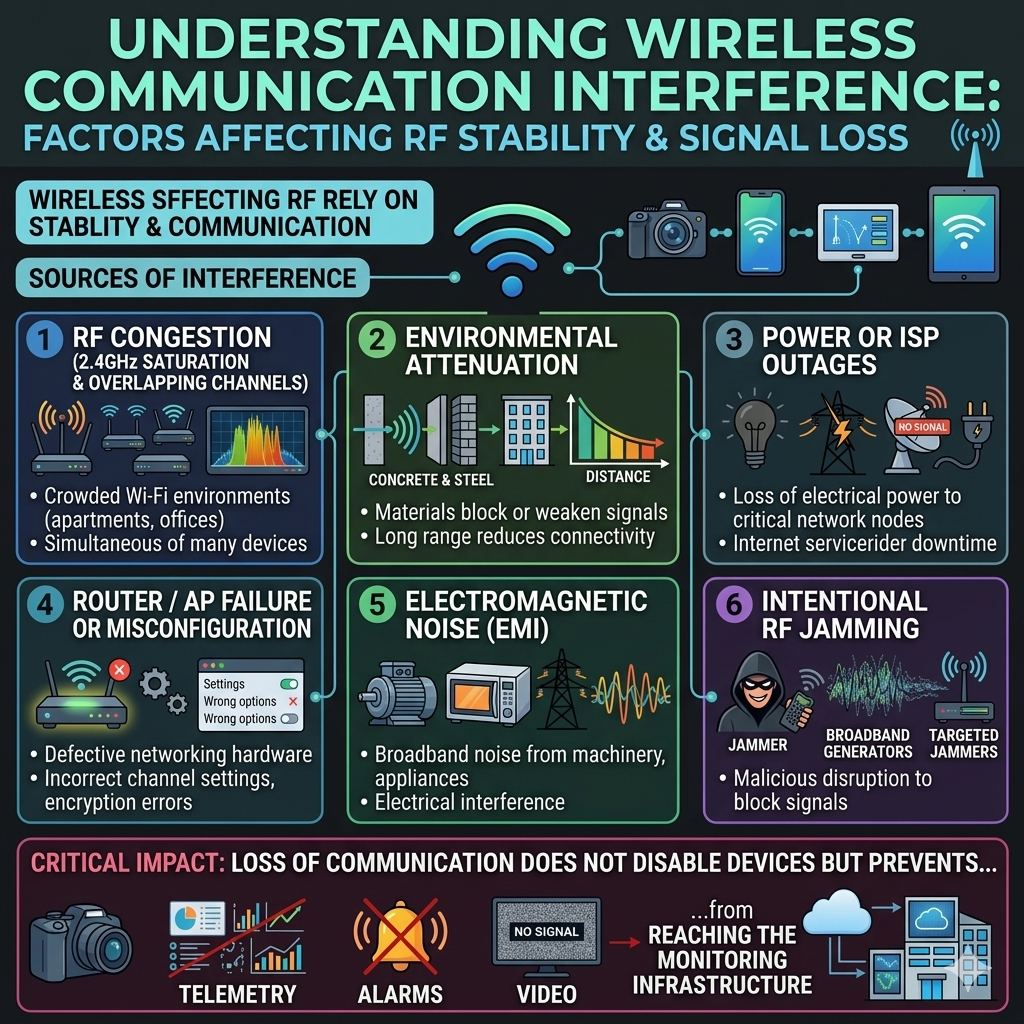
Wireless systems rely on stable RF communication. Interference can originate from:
- RF congestion (2.4GHz saturation, overlapping channels)
- Environmental attenuation (concrete, steel, distance)
- Power or ISP outages
- Router/AP failure or misconfiguration
- Electromagnetic noise
- Intentional RF jamming (broadband noise generators, targeted jammers)
Attack Vector: Communication Suppression
Most interference in residential systems isn't sophisticated hacking it’s deliberate signal disruption. When a home alarm panel or camera loses its ability to transmit, the monitoring centre receives no event data, cloud‑connected cameras can't upload footage, and mobile apps stop delivering notifications. Devices may appear offline or frozen, leaving homeowners unaware of what's happening. Because of this, the communication path itself becomes the most attractive target for interference, and protecting that link is essential to maintaining a reliable, responsive security network.
Impact on Security Systems
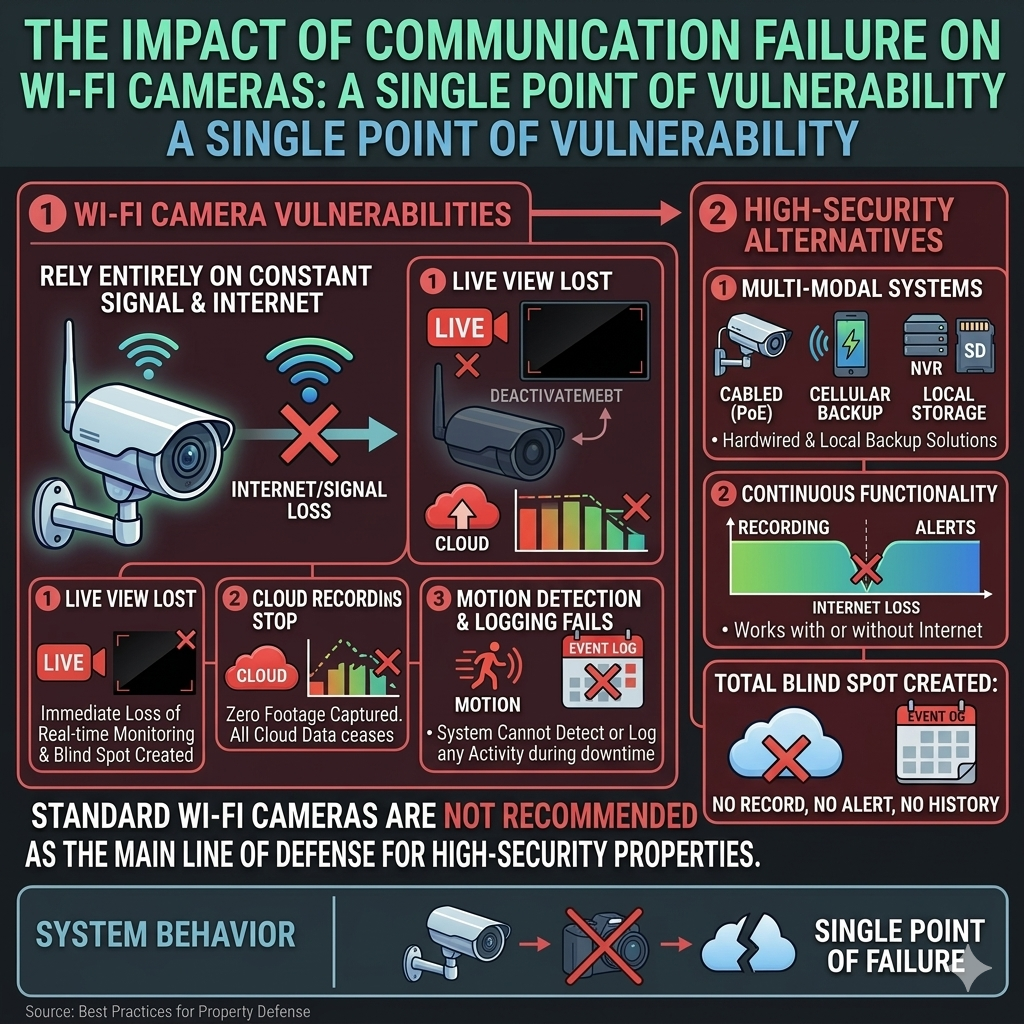
When designing your property's defenses, it is vital to understand that not all security systems handle internet dropouts the same way. Wi‑Fi cameras, for instance, rely entirely on a constant wireless signal and internet connection to work. If your internet goes down or your wireless signal is blocked, these cameras stop working instantly. This means you lose your live view, cloud recordings stop, and the camera will fail to detect or log motion events. Because standard Wi‑Fi cameras have no backup way to send data, a connection failure creates an immediate blind spot. For this reason, these cameras are not recommended as the main line of defense for properties that require high security.
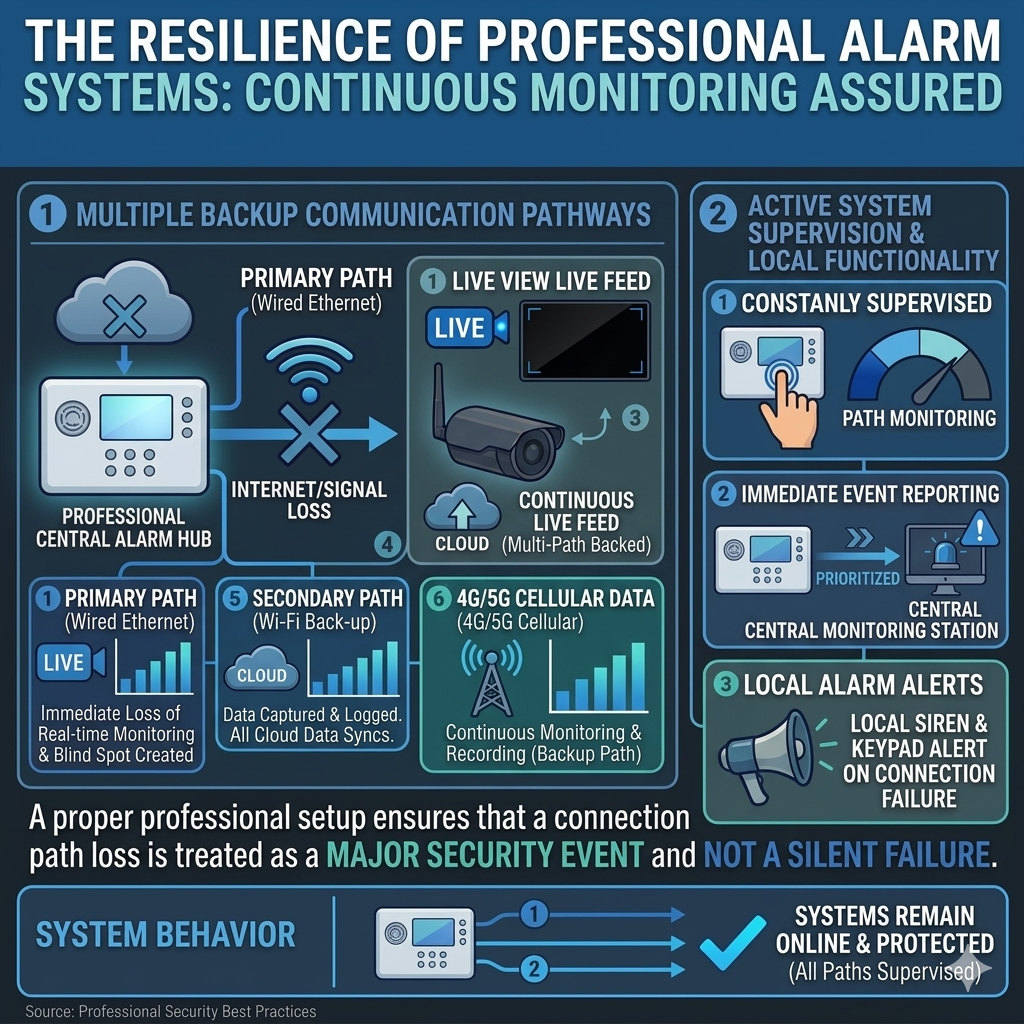
Professional alarm systems, by comparison, are built to keep working even when your main internet connection fails. They use multiple backup pathways to stay online, typically starting with a wired internet cable, switching to Wi-Fi if that fails, and instantly falling back to a 4G or 5G cellular network as a final safety net. A proper professional setup is configured to supervise these paths constantly, report issues immediately, and keep running locally even if the cloud goes offline. If a connection path is cut, the system immediately sounds a local alert and notifies the monitoring center. This ensures that a lost connection is treated as a major security event rather than a silent failure that leaves you unprotected.
Why Ajax Is a Stronger Alternative
Ajax Systems is engineered specifically to address the weaknesses found in traditional wireless security platforms. Their architecture is built around resilience, anti‑jamming, and multi‑layer supervision — making it one of the most robust wireless ecosystems available today.
1. Jeweller Radio Protocol (868MHz)
Ajax doesn’t rely on standard home Wi-Fi for communication between devices. Instead, it uses Jeweller — Ajax’s proprietary encrypted radio protocol operating on the 868MHz frequency band, purpose-built specifically for professional security systems. This gives Ajax greater range, more stable connectivity, and stronger resistance to interference than typical consumer wireless devices.
Because Jeweller operates independently from household Wi-Fi traffic, it avoids many of the congestion, signal dropouts, and reliability issues that affect connected home devices. Motion detectors, sirens, keypads, and sensors remain reliably connected across large properties while using very little power.
Every signal sent across the Jeweller protocol is encrypted, two-way, and continuously supervised. If a device loses connection, the system can detect it immediately. Operating on the dedicated 868MHz band also helps reduce interference from crowded 2.4GHz and 5GHz Wi-Fi networks commonly found in homes and businesses.
This purpose built wireless architecture removes many of the common failure points associated with consumer grade smart security systems, helping ensure your alarm system stays online and responsive when it matters most.
2. Built‑In Anti‑Jamming Detection
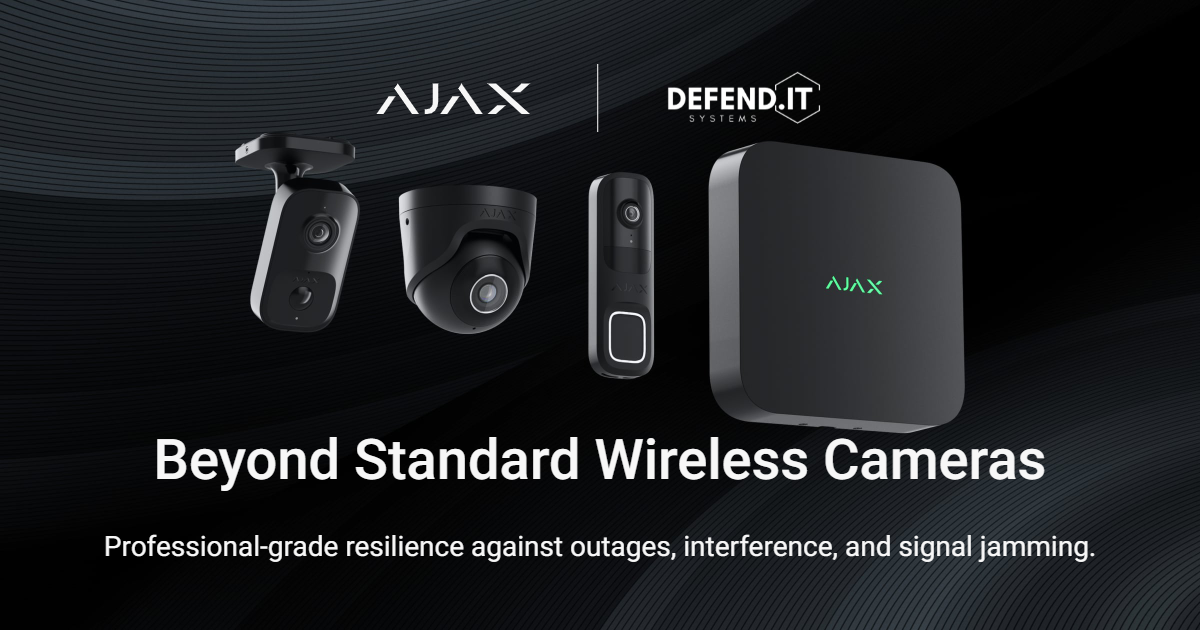
Ajax hubs continuously monitor the surrounding RF environment for signs of wireless interference or deliberate signal jamming. If suspicious activity is detected, the system responds immediately rather than failing silently.
When a jamming attempt is identified, the hub triggers an instant alarm, notifies the monitoring centre, and records the event within the system logs for investigation. This allows security teams and property owners to react quickly to potential tampering or intrusion attempts.
Because wired Fibra devices communicate over a physical connection, they continue operating normally even during wireless interference events. Combined with Ajax’s proprietary Jeweller radio protocol operating on the 868MHz band, this layered approach helps maintain system visibility and reliability during hostile RF conditions.
Instead of treating jamming as a connection problem, Ajax treats it as a security threat.
3. Multi‑Path Communication
Ajax hubs support multiple communication paths simultaneously, helping ensure alarm events continue reaching users and monitoring centres even if one connection becomes unavailable.
Depending on the installation, the hub can communicate over Ethernet, Wi-Fi, and dual 4G/5G SIM connections. If one path fails due to an outage, interference, or network disruption, the system automatically switches to an available backup connection with no manual intervention required.
All communication events, failovers, and connection changes are fully logged and reported in real time, providing complete visibility into system status. This multi-path architecture helps reduce single points of failure and improves resilience against internet outages, carrier disruptions, and wireless interference attacks.
Instead of relying on a single internet connection, Ajax is designed with layered communication redundancy built in.
4. Fibra Wired Bus (Hybrid Architecture)
Ajax Fibra combines the reliability of hardwired security systems with the intelligence and flexibility of modern encrypted infrastructure. Using a secure wired communication bus, Fibra devices maintain fast, stable connectivity while remaining fully integrated with the Ajax ecosystem.
Fibra supports encrypted digital communication with continuous device supervision, tamper detection, and cable integrity monitoring built into the system. With support for cable runs up to 2,000 metres, Fibra is well suited for larger homes, commercial sites, warehouses, and high-security environments where dependable wired infrastructure is critical.
This hybrid architecture allows installers to keep high priority devices such as keypads, sirens, and critical detectors — on hardwired Fibra connections, while using wireless Jeweller devices where installation flexibility is needed. The result is a more resilient security system that combines the stability of wired infrastructure with the convenience of wireless deployment.
By supporting both wired and wireless technologies within the same platform, Ajax provides greater redundancy, flexibility, and protection against communication failures or RF interference.
5. Professional‑Grade Supervision
Ajax devices are continuously supervised to ensure the entire security system remains connected, responsive, and operational at all times. Every device regularly checks in with the hub at defined intervals, allowing the system to verify communication status in real time.
During these check-ins, devices report signal strength, connection quality, and potential interference issues. If communication is interrupted or a device goes offline unexpectedly, the hub immediately generates an alert and records the event within the system logs.
All activity is logged for troubleshooting, audit visibility, and compliance reporting, giving installers, monitoring centres, and property owners a clear history of system events and communication health.
Rather than allowing device failures or signal loss to go unnoticed, Ajax turns communication issues into visible, actionable security events.
Defend.IT Systems Approach
As an Ajax Partner, Defend.IT Systems designs and deploys systems that maintain operational integrity under communication loss, including:
- PoE camera networks with on‑premise NVRs
- Ajax hybrid systems using Jeweller + Fibra
- Multi‑path alarm communicators with automated failover
- Supervised wireless sensor networks
- Hardened network infrastructure
- Monitoring integration with path failure reporting
Our focus is ensuring that communication loss becomes an alert, not a vulnerability.
Need a Security System That Stays Online — Even When the Network Doesn’t?
If you’re relying on Wi‑Fi cameras or single path alarms, your system may be more vulnerable than you think.
Defend.IT Systems designs security solutions that detect, report, and survive communication failures with Ajax as a core technology partner.